There are two very important changes I'd make to this game right from the start: the controls, which are especially relevant in multi-player mode, and the story, which serves as the main motivation for progress in single-player mode.
Controls. There is only one option here: assume each individual player is either using a GameCube controller or a Game Boy Advance as an input device. That is, allow any combination of controllers/GBAs to be possible, and with any number of players. The only disadvantage this brings is the fact that a player without a GBA has no private screen, but I'll shortly show how this can be overcome. First, though, let's check what all the buttons and sticks do, as displayed on the following table.
| Controller | Purpose | GBA |
|---|---|---|
| Control Stick | Move Character (Analogue) | - |
| Control Pad | Move Character (Digital) | Control Pad |
| A Button | Action/Attack | A Button |
| B Button | Perform Selected Command | B Button |
| C Stick (Player 1 Only) | Move Camera (Up and Down also zoom camera) | - |
| X Button | Perform Assigned Command | - |
| Y Button | Perform Assigned Command | - |
| Z Button (Player 1 Only) | Correct Camera Position (double-tap for 1st Person View) | - |
| Left Trigger | Select Previous Command | Left Trigger |
| Right Trigger | Select Next Command | Right Trigger |
| Start Button | Access Menus Player 1 Only: Double-tap to Pause too | Start Button |
| - | Use with the A Button and the Control Pad to control the camera (functions similar to the Z Button and the C Stick) | Select Button (Player 1 Only) |
There are some important differences here. The most obvious is having a separate button for Attack instead of having it as a command, so that players don't have to wade through lots of other commands in the thick of battle just to perform a basic sword slash. Attacking is a time critical action that needs to be available to players at all times in the presence of danger and is way too important for it to be incorporated into a list. Also, the very same button that is used for Attack also serves to carry out context sensitive actions, such as Talk, Open, Examine, Carry, Drop, Throw, ..., simply because you don't want to kill an NPC, or destroy the Crystal Chalice. (Think of Attack as an action to be performed on an enemy, much in the same way that Open is an action done on a chest.) Next, you can see that players can still select commands with the Left and Right Triggers, but now it's the B Button that executes the selected command. And here's a new feature: while building the command list, players can assign any commands to the X and Y Buttons, and they can then press them while on the field to perform the assigned actions. (In order for Mog to carry or drop the Chalice simply press the Action button while standing in front of him! And if we always put him close to the player there is no need to call him!) And lastly, because this is a third person adventure game (groan!), I've included a camera control stick and button. As a player, I like to enjoy the sights! See the landscape! Let's not waste such wonderful graphics by not including this option. And if a GBA is connected to Socket 1, the player using it can press the Select Button to control the camera with the Control Pad and the A Button (and press Select again to revert to the normal controls).
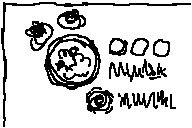
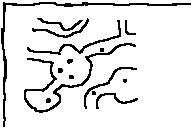
Menus. Now, all these changes to the controls mean that not all players have access to a GBA to display their own private menus. Which in turn means that we must place a player's menu in a corner of the TV screen, if that player is using a controller. The rough sketches below suggest ways to implement this.
 |
 |
 |
 |
| Figure 1 | Figure 2 | Figure 3 | Figure 4 |
|---|---|---|---|
| Default | Menu | Assign | Radar |
By default, Player 1's screen corner displays the view in Figure 1. (The other players' corners are similar.) The large circle represents the player character's face, and to the right of that is the character's health and name. Below the large circle is the B Button action command, and the remaining two circles, above and to the left of the large one, depict the commands assigned to the X and Y Buttons (this, of course, assumes each command has an icon to represent it). If the player is using a GBA these two are not visible. And let us be somewhat bold and not show what the context sensitive A Button does. Let us assume instead that players know that the action that is going to be performed on the entity they have selected is what they are expecting it to be :) (as players, we all want to open a chest when activating it, talk to an NPC when activating that NPC, attack a monster when activating it, and so on).
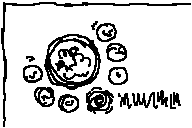
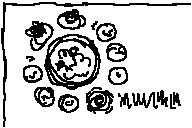
Now, when pressing the Start Button on the GameCube controller, Player 1's screen corner becomes Figure 2. The large circle still represents the player character's face, but now displayed around half this circle are seven (or perhaps just five) of the current menu items - the rest are hidden and fade in/fade out as a different item is selected. The items rotate around the large circle, so that the one that is currently selected is always in the same position relative to the character's face (it is the slightly more scrawled one, with its title beside its icon). If the player activates the currently selected item and it is a submenu, then its icon replaces the character's face and the submenu items replace the items around the large circle, thus becoming the new menu. This helps save screen space and makes everything run slightly faster than if using a different scheme where every menu item and submenu item and so on is explicitly laid out. When a player selects the 'Command List' option from the main menu, the screen corner becomes Figure 3 - it allows that player to check which commands have been assigned to the X and Y Buttons. Finally, when the player selects 'Radar', the face and the menu items become Figure 4. Oh! And all menu options that hog the whole screen, or pause the game, or otherwise disrupt the normal functioning of every player, like 'Map', or 'Save', or 'Diary', or whatever, all belong to Player 1 and to Player 1 alone.
The Map. The first aspect of the landscape that I'd change would be the fact that none of the houses and other buildings in the game can be visited. The second, but more important, would be the roads. I think that making players travel from location to location in an overworld map, as is the case with this game, destroys the illusion of actually being in a fantasy world. Overworld maps allow fast travel between areas, sure, but at too great a cost for the maintaining of a solid gameplay atmosphere. They are relics of RPGs of old and they transmit incoherence. I'd have actual roads to travel in instead, and I'd allow players to enter/exit the caravan at will, and I'd also allow one of them to actually ride it. Of course, in order to make travel interesting, events along the way would have to be setup. So, instead of seeing a cutscene of our heroes being robbed, we could actually cause them to be ambushed by brigands and allow them to respond to this situation (a good unexpected fight can only be a good thing!), or elsewhere they might decide to stop and help some weary travellers arrive at the nearest city, or even lend a spare wheel to a stranded fellow caravan. Roads are places where lots of stuff can happen, and this game would have provided a great opportunity to show that this is so. It helps to build the mood much more effectively than moving an icon on a map, and it also prepares players for the next phase of the adventure. It gives them the feeling of moving on, of having actually finished one stage of their journey and of heading off towards the next. It is important to show players this in the right way, especially in a game about caravans and travel.
The Caravan. And speaking of caravans, this is one feature of Crystal Chronicles that could be put to great use. Firstly, Mog would always be levitating near the caravan (never inside!), leaving it only to help a single player carry the Chalice. While inside their caravan, we could give players the option to rest and replenish their health, or to access a storage area (which would of course be far bigger than a player's backpack) where non-essential items could be kept, for instance. But saving, loading, and joining or leaving a game would also be made while inside the caravan. Player 1 (only) would just need to press the Start Button to access these options. And imagine we have a save file per character, not per game. This would make it easier for any player to join or leave a game with any character - there would be no need to ask for a single- or multi-player mode, nor for the 'Bring a Friend' option and subsequent fiddly swapping of memory cards and unfair restrictions. When loading a character, I wouldn't ask for the memory card slot, I'd present instead a list of all available characters in all the available memory cards, and make the player choose from that list. When saving, I'd overwrite the player's character file without asking, thus updating that character's profile.
Motivation. The one thing in a game of this kind that has the most influence in keeping a lone player captivated and emotionally attached to the characters and their fate in the world is the story. This element isn't as important in multi-player mode as it is in the single-player one, because the sheer pleasure of sharing an enjoyable adventure in the company of friends shies away the relevance of a good plot into second place. But that is not so in a single-player game, and in this case the repetitive nature of filling the Chalice year after year by visiting dungeon after dungeon without any further enticement soon becomes a chore and just not much fun. Having to repeat dungeons just to improve characters only makes matters worse! An imaginative and well structured story would be much more compelling instead. The first thing I'd change to try to accomplish this would be making the main goal of the game the filling of the Crystal Chalice for a single year only and forget about the other years completely. (Other Crystal Chronicles games would worry about those...) And instead of three, it would take some eight to ten drops of myrrh, along with the respective eight to ten dungeons, to completely fill it. For variety, I'd pepper a few more extra dungeons along the way, as sidequests diverting from the main fill-the-Chalice plot for acquiring equipment and artifacts, and as optional quests that players could bypass if they wanted to. Carefully placed events would link all this dungeon-hopping: agreeing to help a couple of rookie caravaners from another village to cross their first dungeon, reacquiring some key item (a royal safe-conduct, perhaps?) stolen from players by some dungeon boss in a rather dramatic cutscene, saving someone who has been kidnapped, helping two warring factions avoid a military conflict, ... But it seems to me that what would really add up to keeping players motivated would be having more rewards in dungeons than just a drop of myrrh. Retaining all the artifacts they find, instead of choosing only one, or finding rare equipment and weapons would be simply awesome, I think. Finally, the game would only end when players arrived at Tipa with the caravan and the filled Chalice, and we could present them with a few more final surprises between the last dungeon and their home village. This last journey home is very important, for adventurers will be crossing the places they had been in before under a new perspective: they are now victorious heroes that have successfully fulfilled their main goal and are returning home to reap the rewards. They expect warm welcomes and congratulations from everyone, especially from everyone in their home village. And if properly done, a couple of setbacks along the way would even help to reinforce their victory! They have left, they have grown up, and they are returning!
The End. Well, here you have it! And even though I have been rather vague about some details, such as the 'Favourites' or the 'Letters' menus, or the placement of bonus info for players without GBAs, I hope the few changes I've described here make you realize that both single- and multi-player modes could have been greatly improved in a simple enough way. Not everyone has a Game Boy Advance, nor friends who like to play games, and that is basically why I think some of these changes would have been important. Don't you agree?
Copyright © 2004 Rui Cuco. All rights reserved.
All trademarks mentioned in these pages belong to their respective owners.